The capital of Greece, which is home to over 650.000 inhabitants and more than 3.5 million in the Attica Metropolitan Region, is one of the most important hubs in the Eastern Mediterranean. Thanks to its frequented airport with more than 22 million passengers and the seaport of Piraeus as one of the largest Mediterranean ports, Athens has been a commercial and touristic centre for two millennia. Even though heritage creates significant challenges for the construction of underground transportation systems, the city administration managed to expand its network to three metro lines of around 90km in total. Nevertheless, a significant of trips are done by passenger cars or motorcycles. In combination with a substantial amount of commuter traffic, the city has significant congestion challenges.
ROAD SAFETY SITUATION
Greece had 30.3 urban road fatalities per 1 million in 2020, which amounts to a total of around 320 fatalities in the Hellenic Republic. Its capital Athens, is the 18-most congested city in Europe, ranked according to the TomTom congestion parameters. Thus, 85 hours per year are lost on average due to congestion, which also has an impact on the stress level of the average driver. In order to calm traffic, 30km/h speed limits are considered a solution.
Additionally, the city administration has already created a dedicated bicycle lane (Vasilissis Olgas), and the plan is to set up bicycle roads within the existing road network (mixed traffic, bike/bus lanes). Both measures are planned to be executed without infrastructure changes. Furthermore, ‘soft engineering‘ measures, such as low-emission zones or congestion charging, are potential solutions that are being considered to reduce the negative externalities of passenger vehicles in the urban area of the Greek capital.
PILOT SCOPE
The focus of the Athens pilot is the road safety of vulnerable road users (VRUs). In order to measure it, profiles and example travel patterns are defined. In a second step, an analysis will place critical emphasis on VRU KPIs, such as speed measurements and modal share of pedestrians, cyclists and similar modes, such as e-scooters.
Different parameters will be taken into consideration, such as disability rate, gender or age. Scenarios will also be created for different times of the day, such as day- or night-time, as well as during peak or off-peak hours.
THE ATHENS GREAT WALK
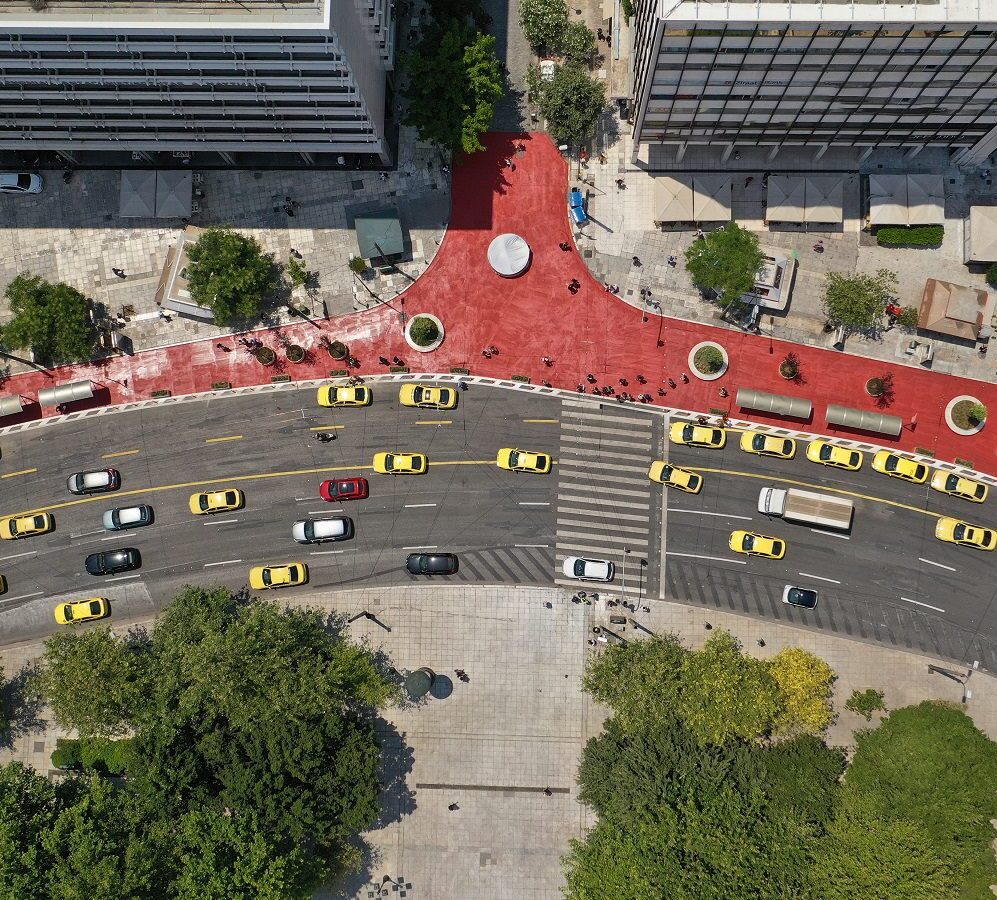
The Athens Great Walk (AGW) project aims to increase public spaces and provide more dedicated spaces for pedestrians and cycling in the historic heart of Athens. Athens Anaplasis is the responsible stakeholder for the implementation process of designed interventions. The aim is to incorporate the project result into the planning of future road infrastructure works and broader urban redevelopment initiatives, enhancing the effectiveness of its interventions.
DEDICATED INTERVENTIONS
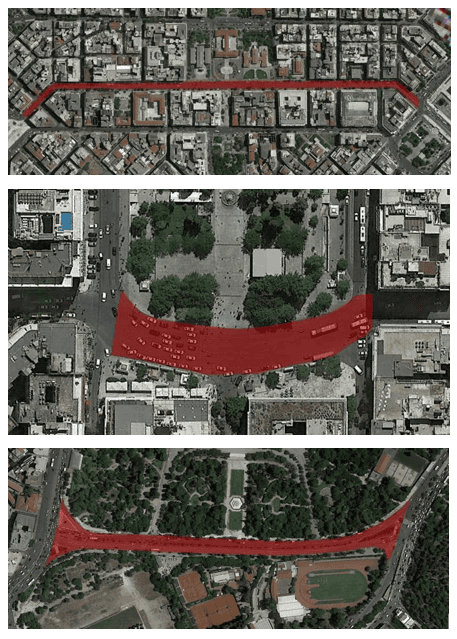
Panepistimiou Street: Increase of sidewalks and decrease from five to four traffic lanes
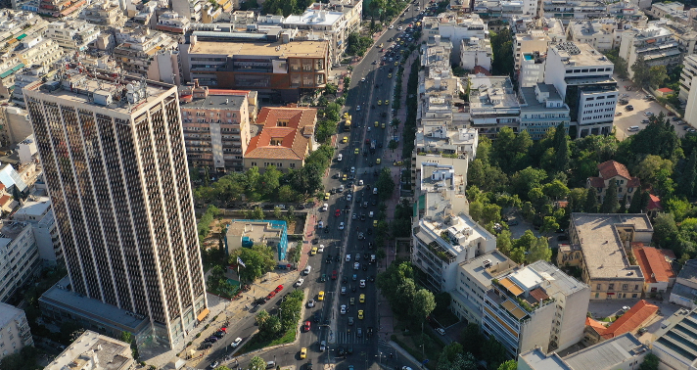
Pavements have been widened along the entire 1,100-metre length of the street, which now comprises three lanes for mixed traffic and one dedicated lane for buses and trolleybuses running in parallel flow. The remaining road width has been redesigned to include cycle lanes and obstacle-free pedestrian pathways, alongside other measures aimed at improving the overall urban environment along this key central thoroughfare.
Syntagma Square: Increase of sidewalks and creation of a dedicated public transport lane
The western side of Syntagma Square has been widened along a 150-metre stretch. Between Karageorgi Servias and Ermou Streets, three lanes serve motorised traffic and one is reserved for bus and trolleybus stops; between Ermou and Mitropoleos, three lanes carry traffic and two serve public transport. Illegal taxi stopping is now banned and enforced, with taxi parking moved to Othonos Street and the sightseeing bus terminus relocated to Stadiou Street.
Vasilissis Olgas Avenue: Exclusive lanes for pedestrians and cyclists
The full 700-metre stretch of Vasilissis Olgas Avenue, between Vasilissis Konstantinou and Vasilissis Amalias Avenues, has been pedestrianised, with motorised traffic prohibited except for emergency and delivery vehicles, which use a dedicated lane one way and the tram lane the other, restricted to off-peak hours. Tram lines remain unaffected. Bus and trolleybus routes 2, 4, 11 and 209 have been diverted via Ardittou and Athanasiou Diakou Streets, lengthening their routes by roughly 500 metres.
EXCLUSIVE BUS LANES & MOTORCYCLE PARKING ARRANGEMENT
Panepistimiou Street: New exclusive bus lane replaces contra-flow arrangement
A new exclusive bus lane has been introduced along the parallel-flow direction, spanning roughly 1,050 metres, while the previous contra-flow bus lane has been removed. This change allows the corridor to serve far more bus lines than before, rising from just three to 26 in total. Several bus routes have been adjusted as a result, with some now terminating earlier and taking alternative roads to reach their destination, improving efficiency and reducing conflicts between opposing traffic flows.
Motorcycle parking management: New parking arrangements
A sufficient number of dedicated parking spaces for motorised two-wheelers has been introduced along a central shopping street, giving motorcyclists reliable alternatives to parking on pavements. The measure aims to reduce pavement obstruction, improve pedestrian access, and encourage more orderly parking behaviour among motorcycle and scooter users in a busy area with high footfall, supporting broader efforts to enhance safety and comfort for pedestrians in the vicinity.
ACHIEVEMENTS
One notable success lies in the preparatory phases, particularly in establishing robust partnerships with stakeholders such as ‘Athens Anaplasis’ and other relevant authorities. Substantial progress has been made in data collection and analysis efforts. Comprehensive datasets on traffic patterns, crash hotspots, and road user behaviours have been compiled, providing valuable insights into the root causes of road safety challenges in Athens. These insights will inform future interventions and allow a more effective targeting of high-risk areas.
PHOEBE enhances the effectiveness of the interventions and maximises their impact on road safety outcomes, proving that the PHOEBE Framework can support cities in promoting safer and VRU-friendly urban environments.