Meet PHOEBE at TRA 2026

The Transport Research Arena 2026 (TRA), taking place from 18–21 May 2026 in Budapest, Hungary, is a gathering for mobility, road safety, and transport experts from across Europe and beyond. As the PHOEBE project enters its final phase, a number of partners are pleased to present project results and contribute their expertise to the iRAP Innovation Workshop. Discover the upcoming events and sessions below.

Technical Session on Transport Safety: Accident Analysis for Enhanced Safety
(Technical Session 1 – 18 May, 08:45–10:15)

PHOEBE partners from TU Delft and NTUA will present the following research:

  • 1418 Amir Hossein Kalantari, Amna Chaudhry, Stella Roussou, Apostolos Ziakopoulos and Amir Pooyan Afghari – A Hybrid Extreme Value Theory Framework for Adaptive Pedestrian Crash Risk Estimation
Technical Session on Road Safety: Protecting Vulnerable Road Users in Transport Systems
(Technical Session 7 – 21 May 2026, 15:30–17:00)

This session will feature PHOEBE experts from NTUA, presenting findings from the Athens pilot analysis conducted within the PHOEBE project:

  • 1417 Marianthi Alverti, Stella Roussou and George Yannis – Investigation of Illegal Pedestrian Crossings at Crosswalks in the Centre of Athens, Greece
  • 1425 Stella Roussou, Natalia Mirogianni and George Yannis – Investigation of Non-Compliant Pedestrian Crossings at Signalised Intersections Using Computer Vision Techniques
  • 1434 Stella Roussou, Apostolos Ziakopoulos, Paraskevi Koliou, Katerina Folla and George Yannis – Video-Based Analysis of Pedestrian Behaviour in Contrasting Greek Urban Environments Using Smartphone Cameras
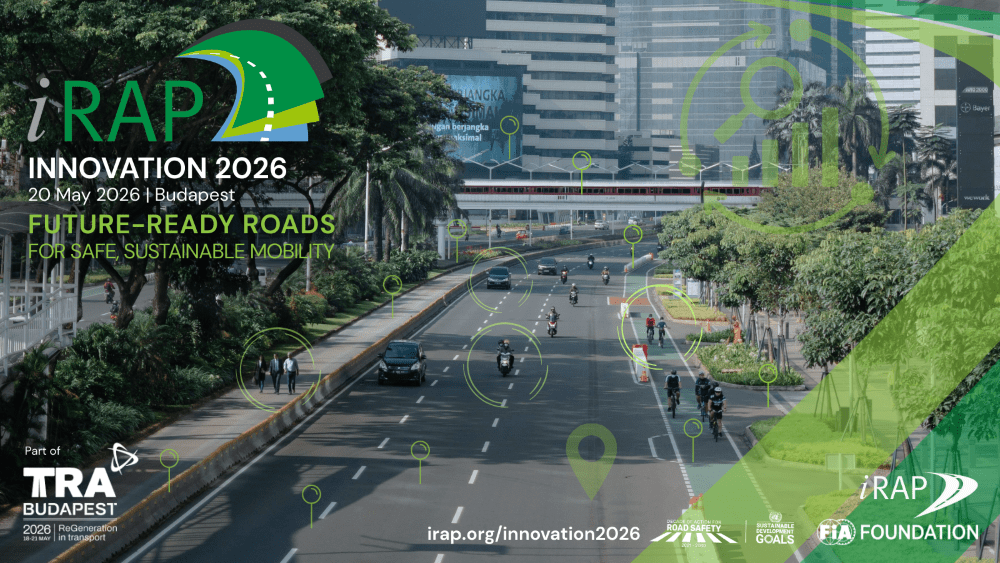
2026 iRAP Innovation Workshop

iRAP’s one-day Innovation Workshop on 20 May promises to be a dynamic and thought-provoking forum, bringing together road safety leaders and experts at the forefront of creating future-ready roads for safe and sustainable mobility. Several PHOEBE partners will present their road safety findings, encompassing road assessment, risk mapping, and predictive analytics designed to support smarter, data-driven decision-making.

PHOEBE welcomes progress on European road safety

New figures released by the European Commission show that road deaths across the EU fell by around 3% in 2025, with approximately 19,400 people losing their lives on European roads, 580 fewer than in the previous year. Whilst any reduction is welcome, the data make clear that progress remains uneven and that most Member States are still not on course to meet the EU’s target of halving road deaths and serious injuries by 2030.

Among the most striking national improvements, Greece recorded a 22% decrease in fatalities, one of the largest drops anywhere in the EU. The PHOEBE project warmly welcomes this result. Our Athens-based partner NTUA attributes this remarkable outcome to stricter police enforcement of helmet-wearing and drink-driving rules, alongside a new Road Traffic Code that came into force in September 2025, which led to a significant improvement in driver behaviour. In concrete terms, 517 people were killed on Greek roads in 2025, compared with 665 the year before, a record saving of 148 lives. As a result, Greece is moving away from the group of lowest-performing EU countries and approaching the EU average for road safety.

Despite such successes, the broader picture gives cause for concern. The Commission’s mid-point report on its Road Safety Policy Framework confirms that, whilst fatalities have fallen, the current pace of improvement remains insufficient to meet the 2030 goal. For every fatality, an estimated five further people suffer serious injuries, meaning that roughly 100,000 people were seriously hurt in road crashes across the EU in 2025. Vulnerable road users, including pedestrians, cyclists, and powered two-wheeler riders, remain disproportionately at risk, particularly in urban areas.

This is precisely the challenge that the EU-funded PHOEBE project is working to address, as we aim to improve road safety for vulnerable road users, including those who rely on active mobility and e-scooters, by combining traffic simulation with road safety assessment.